Striver A2Z
315problems tracked
- Easy
- 60
- Medium
- 209
- Hard
- 46
- Topics
- 22
- Only here
- 109
Deepest coverage. The default if you have 3+ months and want no gaps.
We unified Striver A2Z, Love Babbar 450 and Apna College, removed 297 overlapping questions, and sequenced the 370 core problems for your target role. Practise with built-in execution, visual step-by-step traces, and spaced revision.
Today sample day
167 of 370 problems are core for Backend
A 34 second film about DSA Tracker. Placements are three months away and five study tabs pile up. They close into one site. The Striver A2Z, Love Babbar 450 and Apna College sheets become one list of 370 problems with no repeats, ordered for the job you want. A solution is written, submitted and accepted. Kadane's algorithm runs one step at a time. A revision curve brings a problem back before it is forgotten. AI says what to fix next. Free, and no login is needed to try.
Close the other tabs. The sheets, your progress, the notes, the compiler, the dry-run walkthroughs and the revision reminders all live here.
7 tabs, now one.
Frontend, backend, data or ML, the coding round usually starts with DSA. Clear it, and your projects get their turn.
01
Amazon's own prep page for SDE II lists the steps: a 90-minute online test with two coding questions, then four 55-minute interviews. The first coding resource it links is data structures and algorithms. Your projects come up after that.
Source: Amazon, SDE II interview prep02
Frontend, backend, data, mobile: the format barely changes. What changes is which topics matter most, and this tracker puts those on top for your role.
03
System design needs years on the job and behavioural rounds need real stories. DSA is a fixed list: 22 topics, 370 problems. You can start tonight.
04
Frameworks change every few years. Two pointers, sliding window and binary search work the same across companies and stacks, and stay useful for your whole career.
We track all three, so these are counts from the same 370-problem dataset this app runs on, not a blog's opinion. Whichever you pick, the tracker fits it.
Three sheets, three tabs, the same questions repeated. We de-duplicated them so you never solve the same problem twice.
370
unique problems, one trackerreordered into 30 role paths
75 problems sit in all three sheets. Short on time? Start with those →
Striver A2Z (takeUforward), Love Babbar 450 and the Apna College sheet are the work of their creators. DSA Tracker is independent and not affiliated with them; we link to the originals and write our own notes. Credits · Coverage
315problems tracked
Deepest coverage. The default if you have 3+ months and want no gaps.
248problems tracked
Balanced classic. Same topic spread, ~20% lighter than A2Z.
104problems tracked
Gentlest on-ramp: 45% Easy, only 4 Hard. Start here if you're new.
75 problems appear in all three sheets.
75 problems appear in all three sheets. Solve those first whatever you picked. Only 148 of the 370 are exclusive to a single sheet, which is why switching sheets mid-prep wastes less time than people fear.
See the Consensus 75, the problems all three sheets agree on →Frontend and backend do not need the same DSA. Pick the job you want and the topics that matter for it move to the top; the ones only that role needs are marked.
Order for
Frontend Engineer
84 of 370 problems are core for this role 1 topic is core for Frontend and for no other role in this list.
See the full pathPick the job and the time you have. The plan shows how long that role's core problems take at that pace.
84of 370 are core
Notes, hints and a compiler for every problem on the list, written one problem at a time.
Stuck at 2 a.m. with no way in?
Every problem has notes we wrote ourselves: the idea that unlocks it, the approaches from slow to fast, and the traps.
370 problems with our own notes and 950 examples
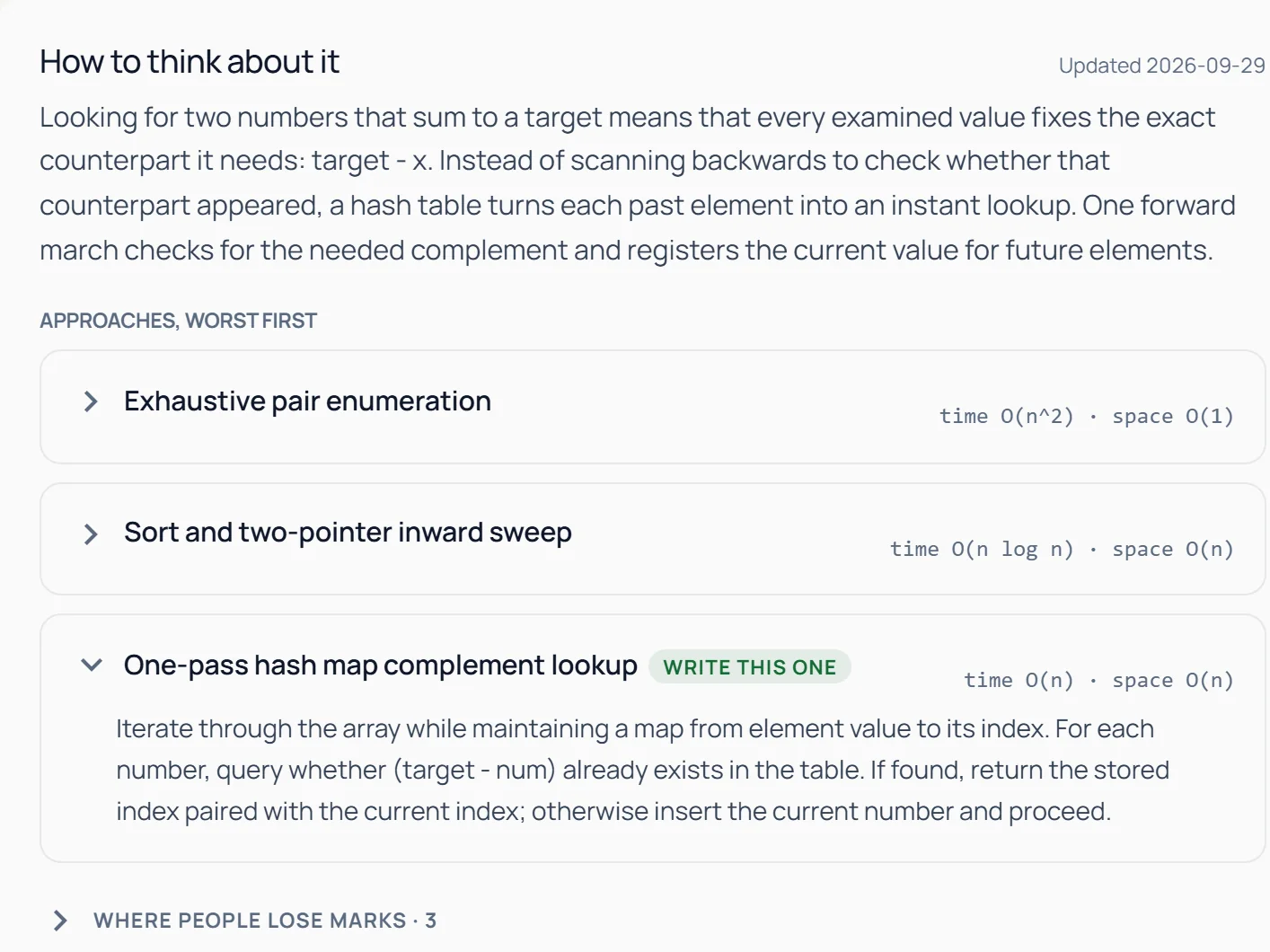
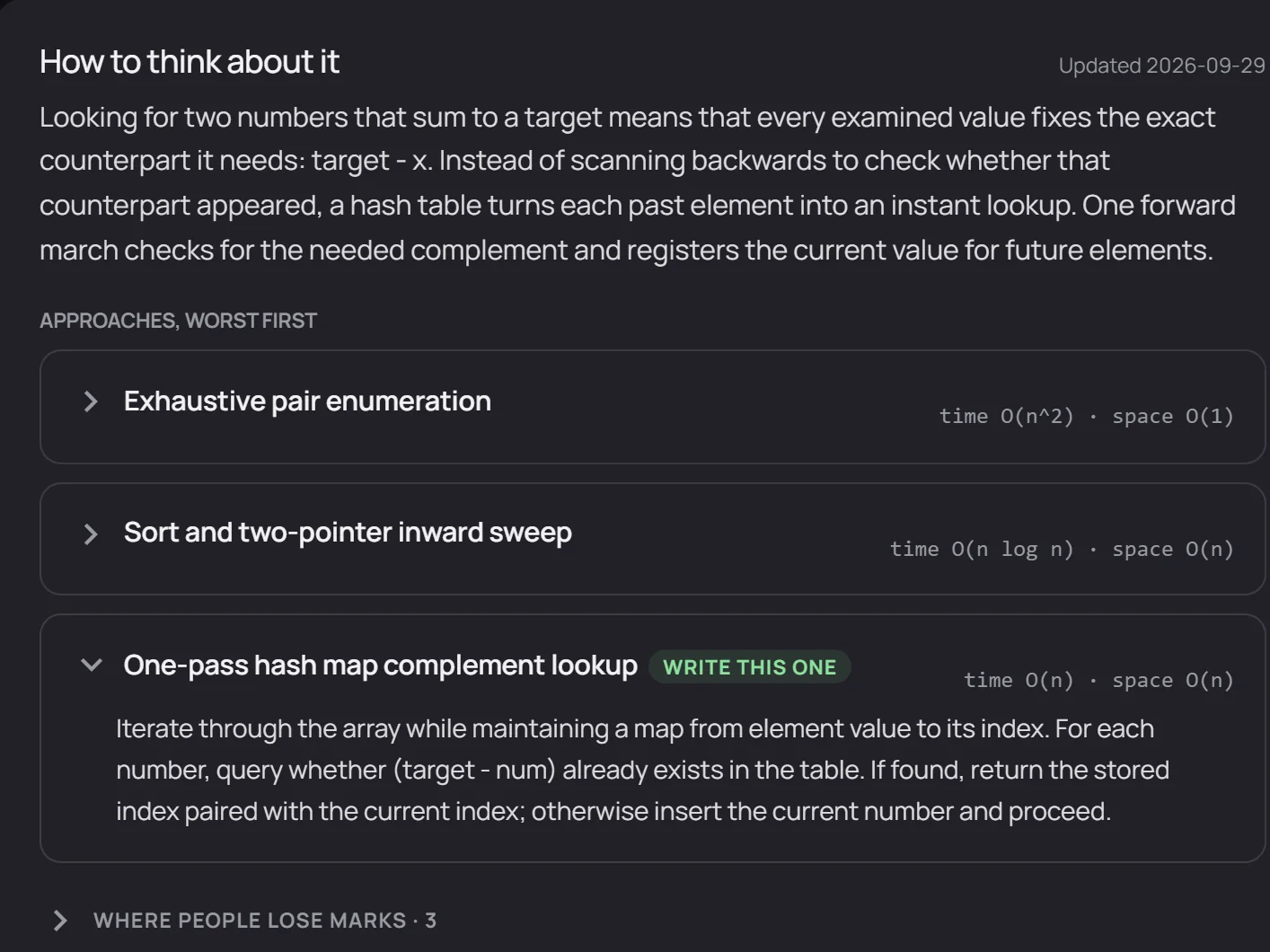
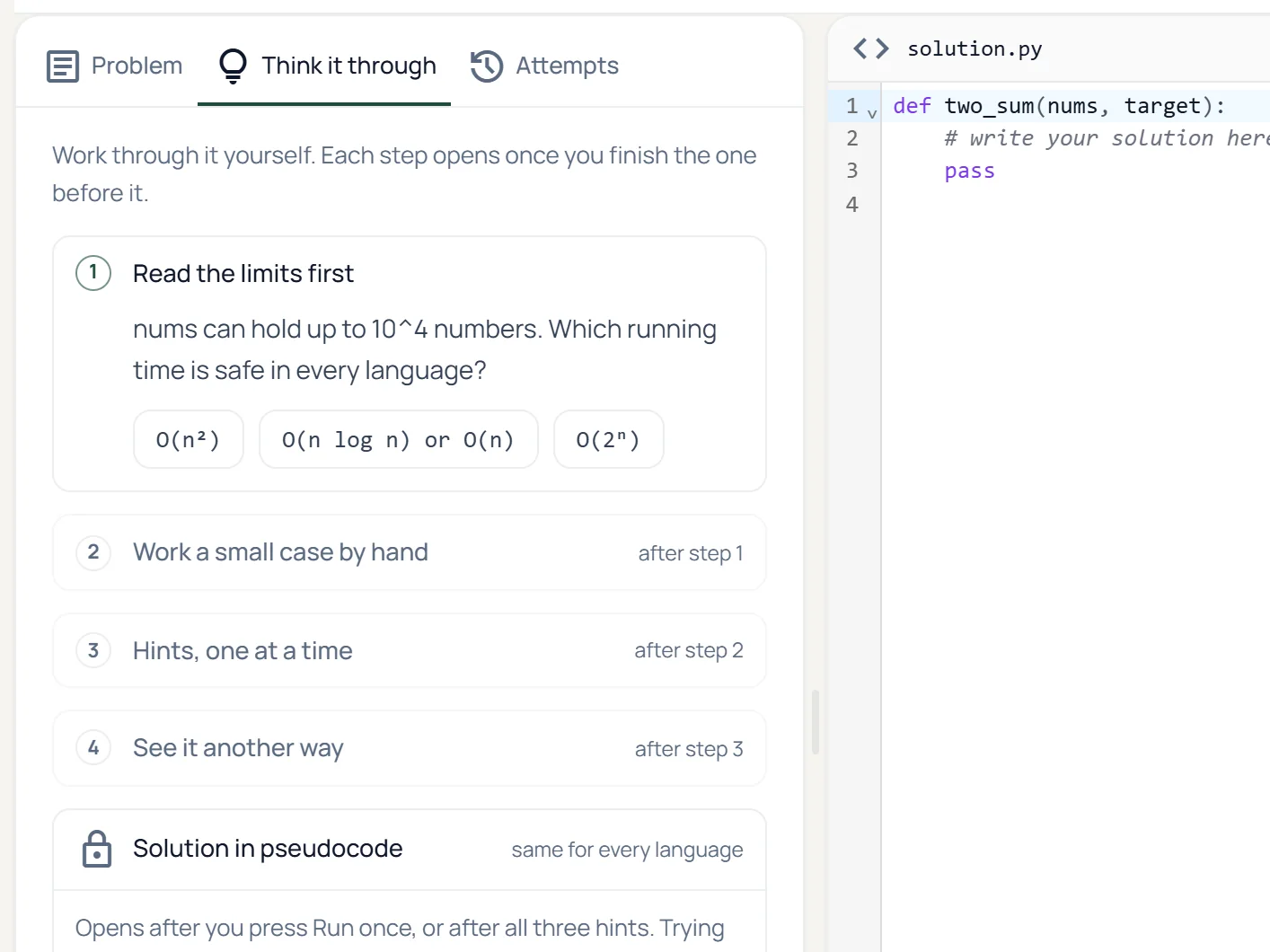
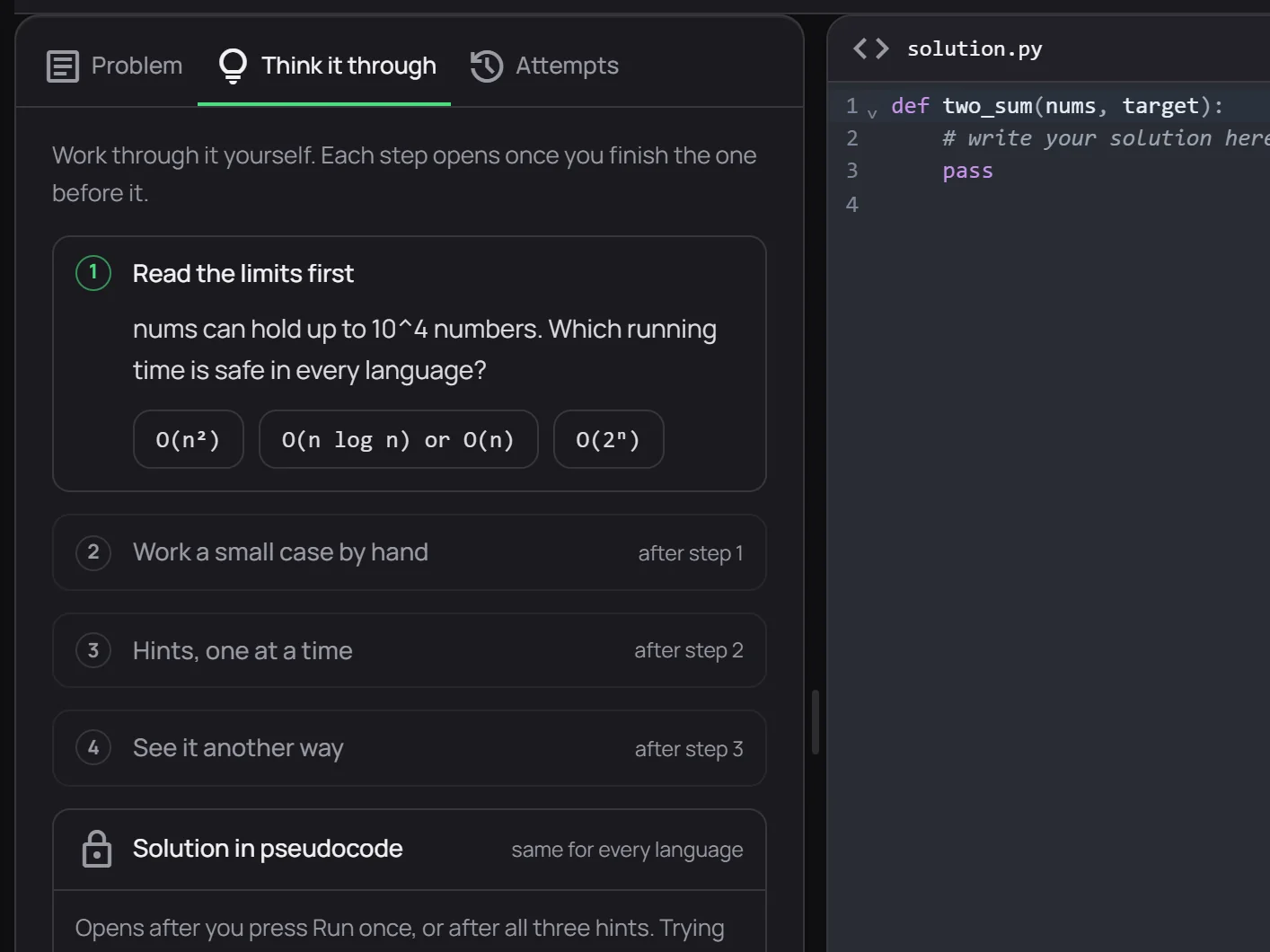
Want a hint, not the answer?
Think it through opens one step at a time: a nudge first, then the approaches, then what usually goes wrong.
Hints on every problem
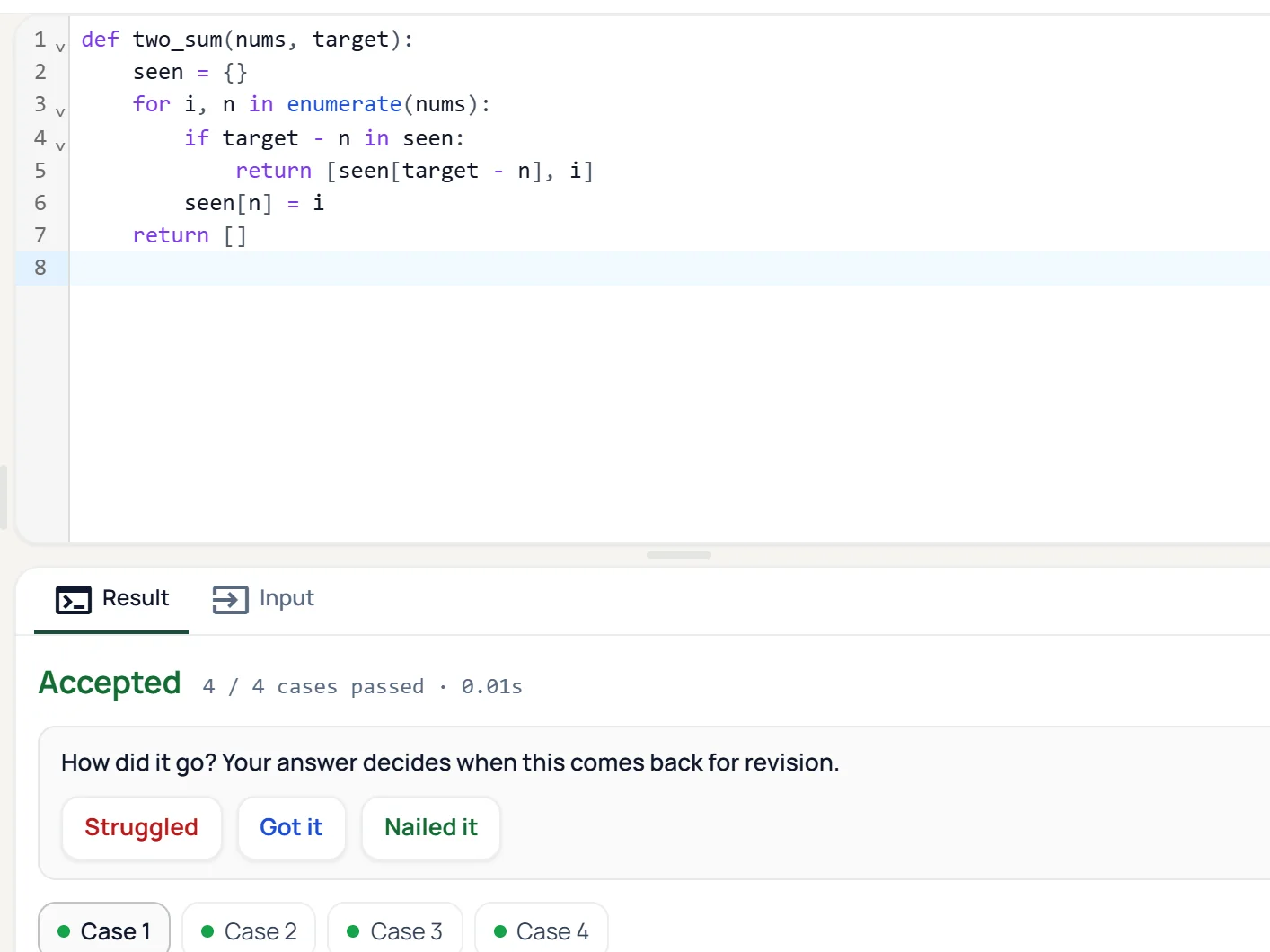
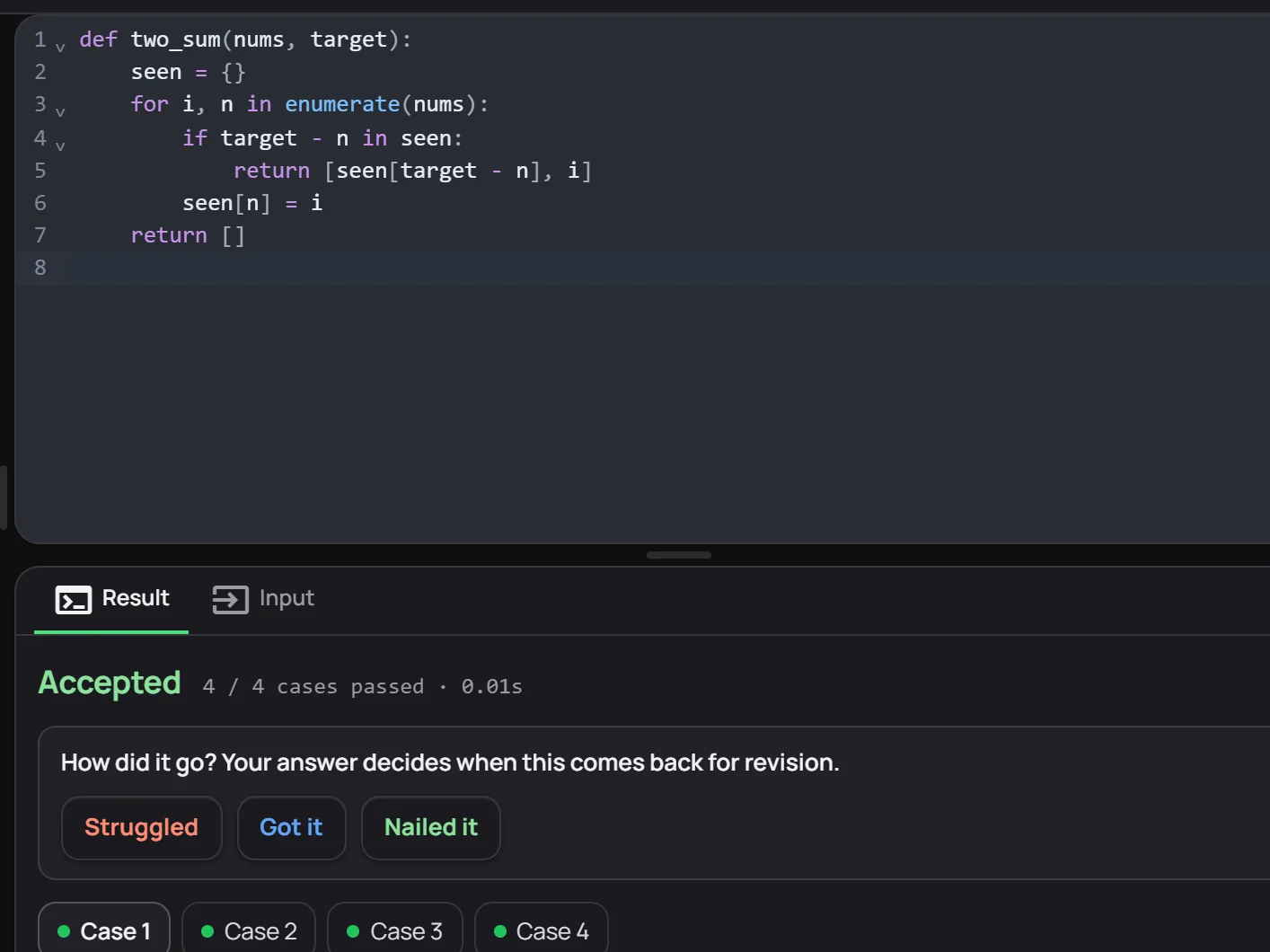
Not sure your code is actually right?
Run code in 9 languages on any problem in the built-in compiler. For 356 of them, submit and it is graded in 4 languages against hidden test cases (C++, Java, Python or JavaScript).
356 problems with hidden tests
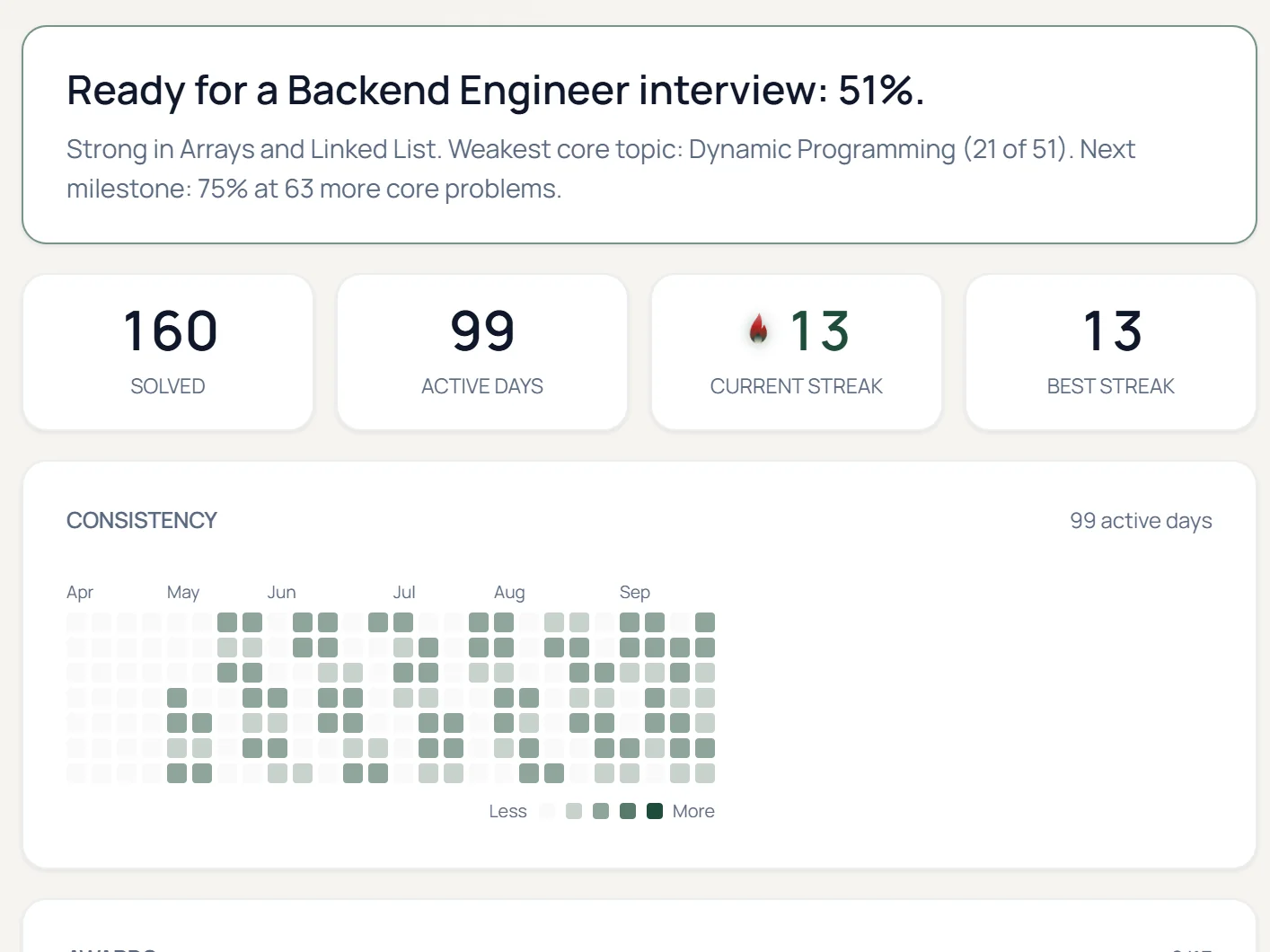
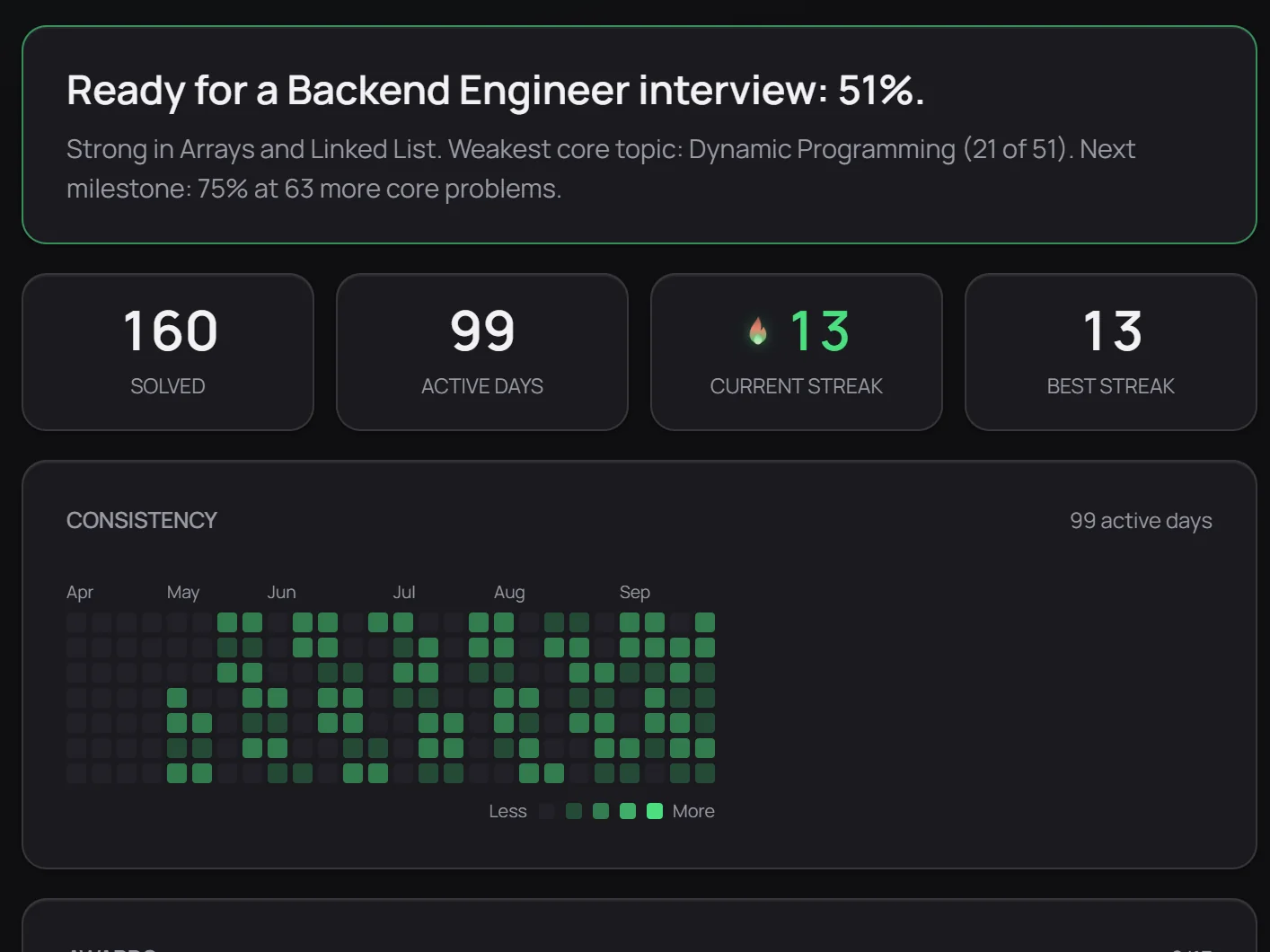
Don't know which topics are holding you back?
The skill analysis reads what you have solved and gives you a readiness score for your target role, plus the skills you are still missing.
AI skill analysis
Every problem has a step-by-step walkthrough: the pointers move, the values change, and the idea stops being abstract.
Sorted array, target 10. Put l on the smallest value and r on the largest — the sum can only be steered from these two ends.
Inspect variables and follow execution step by step. Free, no login, and it runs in your browser with nothing uploaded.
Edit the code above and press Run it. It runs in your browser, and nothing is uploaded.
Ready to trace
Press Run it to watch this algorithm execute step by step.
Need Python, longer files, or a full code editor? Open the full tracer →
Get it right and the gap doubles. Blank on it and it comes back tomorrow.
Opt-in. Off by default. Only aggregate numbers ever show, never your email or notes.
Pulls in the platforms you already grind on
SDE, Frontend, Backend, Data, ML: 30 roles. The same problem set reorders to what that role is actually tested on.
A phase-wise career roadmap with free resources and the exact problems to solve at each step.
Streaks, a heatmap, per-topic mastery and a leaderboard, plus AI skill analysis that tells you what to fix next.
Today's plan
0 / 3
Streak
0 days
This week
₹0
forever
Coming soon
Every one of the 22 topics in the 370-problem set, with how many problems live there.
A DSA tracker is a tool that keeps your data-structures-and-algorithms practice in one place: which problems you have solved, which topics are weak, and what to attempt next. Most trackers stop at a checklist. DSA Tracker also reorders the 370 problems across Apna College, Love Babbar 450 and Striver A2Z to match the role you are interviewing for, so the order you practise in is the order that role actually asks in.
Grinding 3,000 problems leads to burnout and duplicate effort. Striver A2Z, Love Babbar 450 and Apna College together contain 667 question slots, but 297 of them repeat a question from another sheet. DSA Tracker merges them into 370 unique core problems, prioritized for your target role so you master concepts instead of grinding random variations.
Yes, every feature is free, forever: all problems, sheets, roadmaps, skill analysis, platform sync and your portfolio. Nothing ever moves behind a paywall.
Apna College, Love Babbar 450 and Striver A2Z, three widely used Indian DSA sheets. DSA Tracker merges them into one de-duplicated list and reorders it; full credit stays with their authors.
Pick a target role and the same master list of problems resequences to that role's priorities, so a frontend dev isn't starting with the exact same practice plan as a data engineer.
It reads your solved history, your target role and the skills you list, then returns a readiness score, your weak topics and what to do next. You always get an answer, and every result is labelled with what produced it.
Striver A2Z is the deepest (315 of our 370 problems, 22 topics); Love Babbar 450 covers the same 22 topics ~20% lighter (248); Apna College is the gentlest start (104 problems, 45% Easy). 75 problems appear in all three. Start there, then follow whichever sheet you picked. DSA Tracker tracks all three, so the choice isn't permanent.
There's no honest universal number, but the shape is consistent: cover every core topic before going deep in any one. That's what the role ordering does. It puts your role's core topics first instead of making you grind a fixed list top-to-bottom.
No. You solve on LeetCode or GeeksforGeeks like always, and this tracks it. Sync your LeetCode handle and recent accepted solves get marked automatically.
Guest mode keeps a few marks on your device so you can try it, but nothing syncs until you create a free account. Signing in later keeps everything on any device.
No. dsatracker.tech is the only website run by this project. dsatracker.in is a separate site with a similar name that we do not own or operate, so numbers listed there, such as a 1,464-problem roadmap, are not ours. DSA Tracker at dsatracker.tech has 370 curated problems across 22 topics, reordered for 30 job roles.
Profile trackers show totals from LeetCode and other sites. DSA Tracker orders 370 problems for your target role, plans a short daily set, schedules revision, and syncs your recent LeetCode solves from just your username.
DSA Tracker reorders 370 curated DSA problems (Apna College, Love Babbar 450, Striver A2Z) around the role you're actually preparing for, then layers AI skill-analysis and progress tracking on top, free.
Start free